From Reversal Risk to Contracted Durability: Kita’s Solutions Suite

Permanence and durability have risen rapidly up the carbon market agenda in 2026. They are no longer viewed solely as technical considerations within project methodologies and are becoming central to the next phase of market structure, integrity and growth.
At Kita, we view permanence and durability through two complementary lenses:
As a risk management challenge: reversal risk can be identified, assessed, mitigated, priced, monitored and transferred.
As a market infrastructure opportunity: financial, contractual and institutional mechanisms can allocate reversal liability and manage it across the required durability threshold, reducing reliance on individual companies to carry long-term obligations alone.
Durability does not require a physical asset to be indestructible. Consider buildings: although they may appear permanent, they remain exposed to fire, flooding, earthquakes and other events that can damage or destroy them. Their long-term value and function are supported by an institutional framework combining construction standards, ongoing maintenance, clearly assigned responsibilities and insurance. When a covered event occurs, this framework can provide the resources needed to repair or rebuild, allowing the asset’s function and value to be restored even when its physical continuity is interrupted.
Carbon storage can be approached through a similar lens. No removal and storage pathway is entirely free from reversal risk, and durability should not depend solely on assumptions about which pathways are inherently permanent. Instead, legal, financial and institutional mechanisms can assign liability, support monitoring and mitigation, and provide compensation when reversals occur. Maintained across the required durability threshold, this infrastructure can make carbon projects durable and enable a wide range of pathways to be evaluated on their performance.
Kita is actively contributing to the development of this market infrastructure. This explainer examines emerging approaches to reversal risk management and how Kita’s growing suite of project, registry and system-level solutions fits within this landscape. It is intended to help carbon market participants understand how these solutions work together and where each can support their specific risk management needs.
Definitions
We use various terms in this blog, so please see high-level definitions below.
Reversal: reversal is the physical loss of carbon dioxide from a stored state to back into the atmosphere. Reversal is the risk that happens that impacts upon permanence.
Permanence: permanence is the desired outcome, in that once carbon dioxide is stored, it should remain as such permanently. Permanence itself is a challenging target, however we believe infrastructure can be put in place to maintain permanence over time (e.g. as we expect in all sorts of other parts of the world economy, such as physical infrastructure like buildings, bridges and road).
Durability: durability is another way of defining permanence, where we can view the ongoing maintenance of permanence via durability thresholds. For example, the likelihood of durability can be assessed per project (a risk score); contracted durability can be managed over time, e.g. via contractual means that assign liability to fix any reversal event; and then realised durability can be tracked, via looking at the expected durability vs the identified losses and reassessing the durability scoring over time (in essence, the function used in all risk markets to continuously update risk pricing tools).
For Kita (in the context of permanence discussions), “reversal” is the risk we are protecting against. “Permanence” is the goal of the market, which is why reversal risk requires protection. Durability is a framework via which our insurance protection can be utilised over time, to contractually fix reversal and build the infrastructure upon which permanence (or contracted durability) can be realised and trusted.
The durability problem
Reversal risk is the possibility that carbon stored or protected by a carbon project is subsequently released back into the atmosphere, reversing some or all of the climate benefit represented by the associated carbon credits.
The market has often taken a binary view of durability. Carbon dioxide removal pathways with a material risk of reversal are likely to either be:
Excluded because they cannot inherently meet long-term durability requirements; or
Admitted without mechanisms that clearly assign and manage reversal liability across the full required durability period.
Neither outcome serves the carbon market well. The first risks excluding high-quality projects that could make an important contribution to climate goals, while the second creates an integrity gap if no party remains responsible for addressing reversals after project monitoring obligations end.
The durability challenge is therefore not simply which carbon pathway is used. It is whether credible legal, financial and institutional infrastructure exists to prevent and monitor reversals, compensate for them when they occur and maintain liability beyond the project’s monitoring period. At Kita, we believe that building this infrastructure is essential to delivering durable climate outcomes while enabling a wider range of carbon removal pathways to participate in the market.
Encouragingly, a framework has emerged that could provide the foundation for this infrastructure. Kita is closely involved in this evolution and is actively contributing to the development and implementation of several of its supporting mechanisms. In this guide, we focus on this framework – contracted durability – that could shape the future of reversal risk management, before exploring how Kita’s solutions support its practical application.
Contracted durability: a promising solution to the durability problem
Contracted durability is a performance-based framework that uses legal and financial mechanisms to make durability an enforceable obligation at the credit level. Because it focuses on the durability outcome rather than the inherent characteristics of a particular carbon removal and storage pathway, it can be applied across different carbon pathways and aligned with policy-defined durability thresholds.
The framework requires two essential functions to be maintained across the full durability threshold:
Ongoing liability for reversals; and
Adequately resourced mechanisms to compensate for reversals when they occur.
Contracted durability can be delivered through a combination of established and emerging mechanisms:
Buffer pools: Withhold a proportion of issued credits to provide first-loss protection against reversals during the crediting and monitoring periods.
Insurance: Transfers the financial consequences of defined reversal risks, including correlated or outlier losses that could overwhelm a buffer pool, at the registry- or portfolio- and the project- levels.
Horizontal stacking: Replaces an original credit at the end of its monitoring period, carrying the storage obligation forward until the required durability threshold is met.
A permanence fund or trust: An endowed institution, funded through a risk-adjusted per-credit fee at issuance, that assumes responsibility for monitoring and compensating reversals over the relevant durability period.
These mechanisms can perform complementary roles across different timescales. Buffer pools and insurance provide important protection during the crediting and monitoring periods, while horizontal stacking or a permanence trust can carry liability beyond those periods. Used together, they can assign reversal liability to clearly identified parties and maintain the resources required to compensate for reversals across the full policy-defined durability threshold.
How does contracted durability differ from existing approaches?
Contracted durability is not intended to replace established risk management solutions. Rather, it provides a framework for combining them with mechanisms that maintain liability and compensation across the full durability threshold.
Buffer pools, maintained by carbon standards and registries, are the market’s most established mechanism for compensating reversals. They continue to play an important role, but face two limitations when used on their own:
Limited duration: Buffer pools were generally designed to compensate for reversals during the crediting and post-crediting monitoring periods, which typically range from five to 100 years depending on the registry. Policy-defined durability thresholds may extend considerably further.
Correlated risk: Buffer pools may contain credits exposed to similar underlying hazards as the projects they protect. A widespread event, such as severe wildfire or drought, could therefore affect multiple contributing projects and place pressure on the shared reserve simultaneously.
Buffer pools form an important part of contracted durability but cannot deliver it alone where the required durability threshold extends beyond the monitoring period.
Insurance provides another essential layer by transferring the financial consequences of defined reversal risks to a rated balance sheet. It can protect individual projects or provide a financial backstop for buffer pools, including against correlated or outlier losses. Insurance policies are generally written for finite periods, however, and extending protection over very long durability thresholds would require repeated renewals. The cumulative cost of premiums over decades or centuries could therefore become substantial.
Contracted durability builds on these established mechanisms by incorporating solutions such as horizontal stacking and a permanence fund or trust. These can maintain clearly assigned liability and the resources needed to compensate for reversals after the post-crediting monitoring period has ended. Together with buffers and insurance, they can support durability across the full threshold required by policy, whether that is 100 years, 200 years or into perpetuity.
Kita’s solutions suite for contracted durability
At Kita, we believe that credible reversal risk management requires both effective tools and the institutional infrastructure needed to deploy them across different timescales, which closely aligns with contracted durability as described above.
Kita has been actively involved in developing and implementing solutions across this framework. Our suite operates at project, registry and system levels and can support all project types. We assess the specific risks associated with each project and tailor our solutions, basing ourselves on performance and not the carbon pathway.
Risk intelligence reports and advisory services
Effective reversal risk management begins with identifying, assessing and mitigating the underlying risks. Kita’s Risk Intelligence reports and advisory services help stakeholders assess, price, manage and monitor reversal risk from an insurer’s perspective.
Our capabilities operate at two levels:
At project level, we use insurance-grade analytics to identify, quantify and monitor reversal risk, taking account of the project’s pathway, location, design, management and mitigation measures.
At registry or portfolio level, we support carbon standards and registries by assessing the resilience of their buffer pools and helping calibrate project contributions according to risk.
These capabilities provide the analytical foundation for Kita’s registry and project-level insurance solutions.
Insurance solutions
Insurance provides a regulated and creditworthy mechanism for transferring the financial consequences of defined reversal risks. Kita offers protection at both registry and individual project level.
(A) Buffer Depletion Insurance (BDI)
Kita’s Buffer Depletion Insurance is designed to provide additional protection for carbon standards and registries that operate buffer pools. It does not replace the underlying buffer, instead it provides a creditworthy financial backstop against unexpectedly high losses that could deplete the pool to a level that threatens its ability to meet future reversal claims.
By protecting against outlier loss, Buffer Depletion Insurance can strengthen the resilience of the buffer pool and increase confidence that it can continue to perform its intended function under stress. Even if a market participant seeks to reduce its reliance on buffers over time, this policy is still highly beneficial for managing the existing liability within current buffers and increasing transparency around risk and loss for market stakeholders.
The policy operates at the registry level, whereas Kita’s Non-Permanence Risk Insurance (explained below) operates at the project level and protects against reversal risk associated with an individual project. They can work in complement to each other.
(B) Non-Permanence Risk Insurance (NPRI)
Kita’s Non-Permanence Risk Insurance addresses carbon reversal risk at the individual project level. The policy transfers the financial consequences of covered reversal events to a rated insurance balance sheet. Where carbon standard rules permit, it can complement existing requirements by reducing or replacing a project’s buffer contribution. The benefits of NPRI are as follows:
It allows a greater proportion of issued credits to be sold during the project’s critical early years
Additional near-term sales can strengthen early project cash flows, provide greater capacity to meet development and operational costs and improve the project’s overall economics
The independent underwriting process can also give buyers, investors and other stakeholders further confidence in how the project’s reversal risks have been assessed
For projects that are not required to contribute to a buffer, the policy can also be used directly between a project developer and a buyer to address agreed durability requirements.
Kita is proud that our Non-Permanence Risk Insurance has been approved for use within Verra’s Durability Pilot allowing eligible Agriculture, Forestry and Other Land Use and Geological Carbon Storage projects to use an approved insurance or fund-based approach instead of contributing to the relevant buffer pool. We are also proud for Isometric’s approval of our Non-Permanence Risk Insurance to be used within its new insurance framework for Reforestation projects. These developments provide project developers with a new way to manage reversal risk while potentially reducing the opportunity cost of setting aside credits.
The Permanence Trust
The Permanence Trust, conceived by the American Forest Foundation, is being developed to address this long-term challenge at the system-level. The proposed model would calculate the financial resources that need to be set aside today, pool and grow those resources over time, and deploy them actively to:
Prevent reversals where possible;
Support long-term monitoring;
Remedy reversals when they occur; and
Provide recourse over the relevant durability period, including after the original project and its monitoring obligations have ended.
The American Forest Foundation is working with Kita and Climate Resilient Solutions on a feasibility study for the Permanence Trust, supported by an advisory group representing stakeholders from across the carbon market.
The Trust is designed to complement existing tools. As discussed previously, insurance can address defined reversal risks over the nearer term, including gaps that arise while the Trust’s resources accumulate. The Trust is then expected to provide the institutional continuity and long-term pool of capital needed to manage liability beyond the practical tenor of an insurance policy or the life of an individual project.
This combined approach also aligns with the emerging concept of contracted durability: achieving a specified durability outcome through enforceable obligations and supporting financial and institutional mechanisms, rather than relying only on assumptions about the inherent permanence of a carbon removal pathway.
By supporting different project types and durability thresholds through a consistent framework, the Permanence Trust could also improve comparability between carbon removal pathways and help a wider range of projects attract investment.
Kita’s reversal risk management suite at a glance
Spanning risk assessment, insurance and long-term institutional stewardship, Kita’s reversal risk management suite is summarised below in the order of each solution’s level of application, from the project and registry levels through to the wider system or institutional level:
Risk Intelligence to help projects, carbon standards and registries identify, assess, mitigate and monitor reversal risk at project and registry or portfolio level.
Non-Permanence Risk Insurance to transfer defined project-level reversal risk and, where permitted, reduce or replace buffer requirements.
Buffer Depletion Insurance to protect carbon standards and registries against outlier losses that threaten the resilience of their buffer pools.
The Permanence Trust, which Kita is helping to develop with the American Forest Foundation and Climate Resilient Solutions, and which is designed to provide a durable institutional and financial structure for managing liability over the very long term.
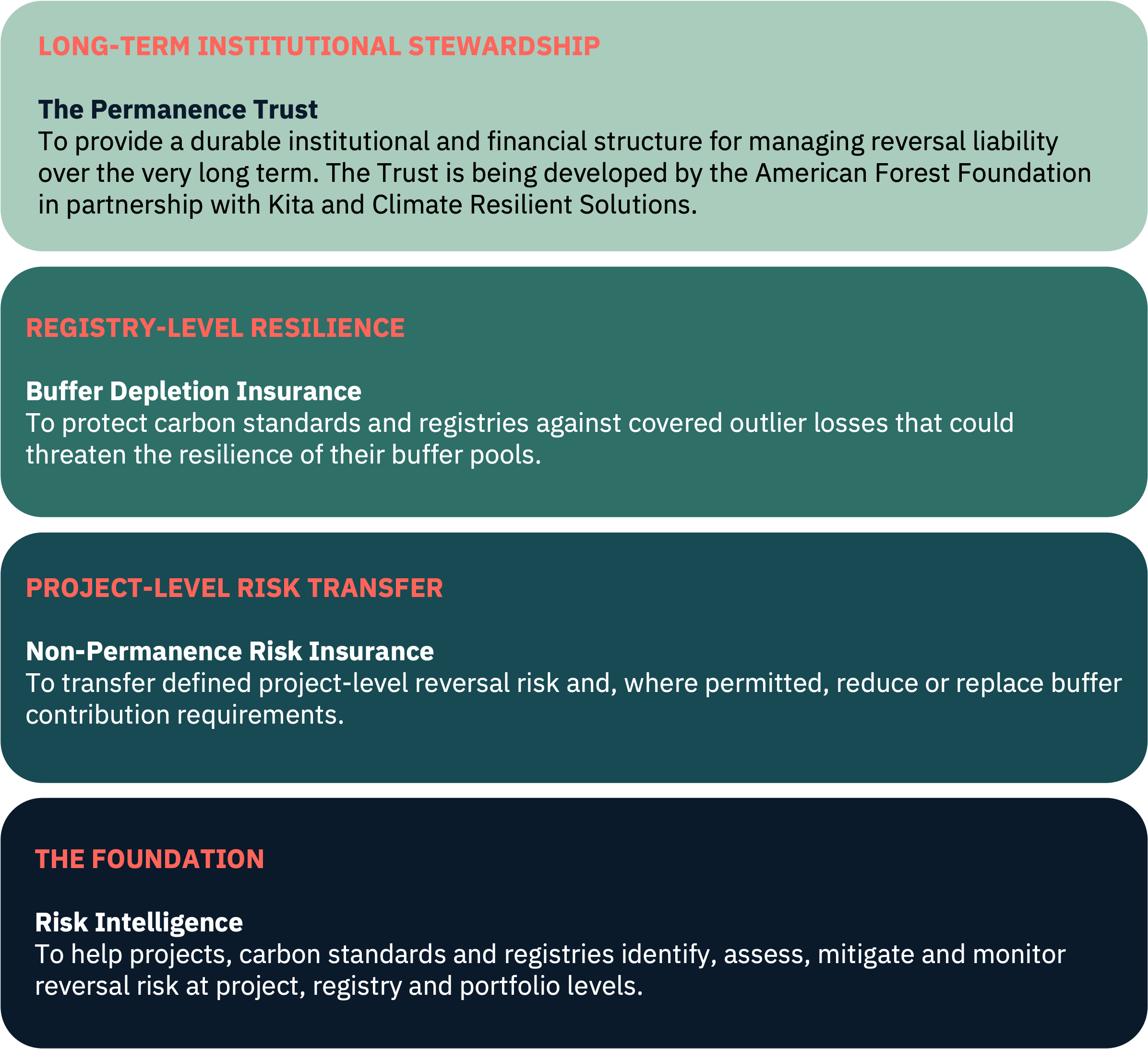
Together, these solutions combine insurance-grade risk assessment, proactive risk management, regulated financial protection and the development of long-term institutional infrastructure. They support stakeholders across the risk management journey, from understanding and mitigating reversal risk to transferring residual risk and managing liability over longer timescales.
Carbon markets will never be risk-free, nor do they need to be. Other high-value markets are able to scale, in part, because risks are made visible, allocated to the parties best placed to manage them and supported by credible legal and financial infrastructure.
Permanence should be approached in the same way. With the right combination of risk assessment, active management, insurance and long-term institutional solutions, reversal can become a risk the market is equipped to manage, rather than a barrier to financing the carbon projects the world urgently needs.
To discuss Kita’s Risk Advisory, Non-Permanence Risk Insurance or Buffer Depletion Insurance, or to learn more about our work on the Permanence Trust, please get in touch.
Suggested further reading
